Nakshatra Meaning: Your Vedic Birth Star Explained
Nakshatra meaning explained: the 27 Vedic birth stars, how your Moon nakshatra and pada shape personality, dasha timing and Kundali Milan matching.
 By SaahilAstrological Guide
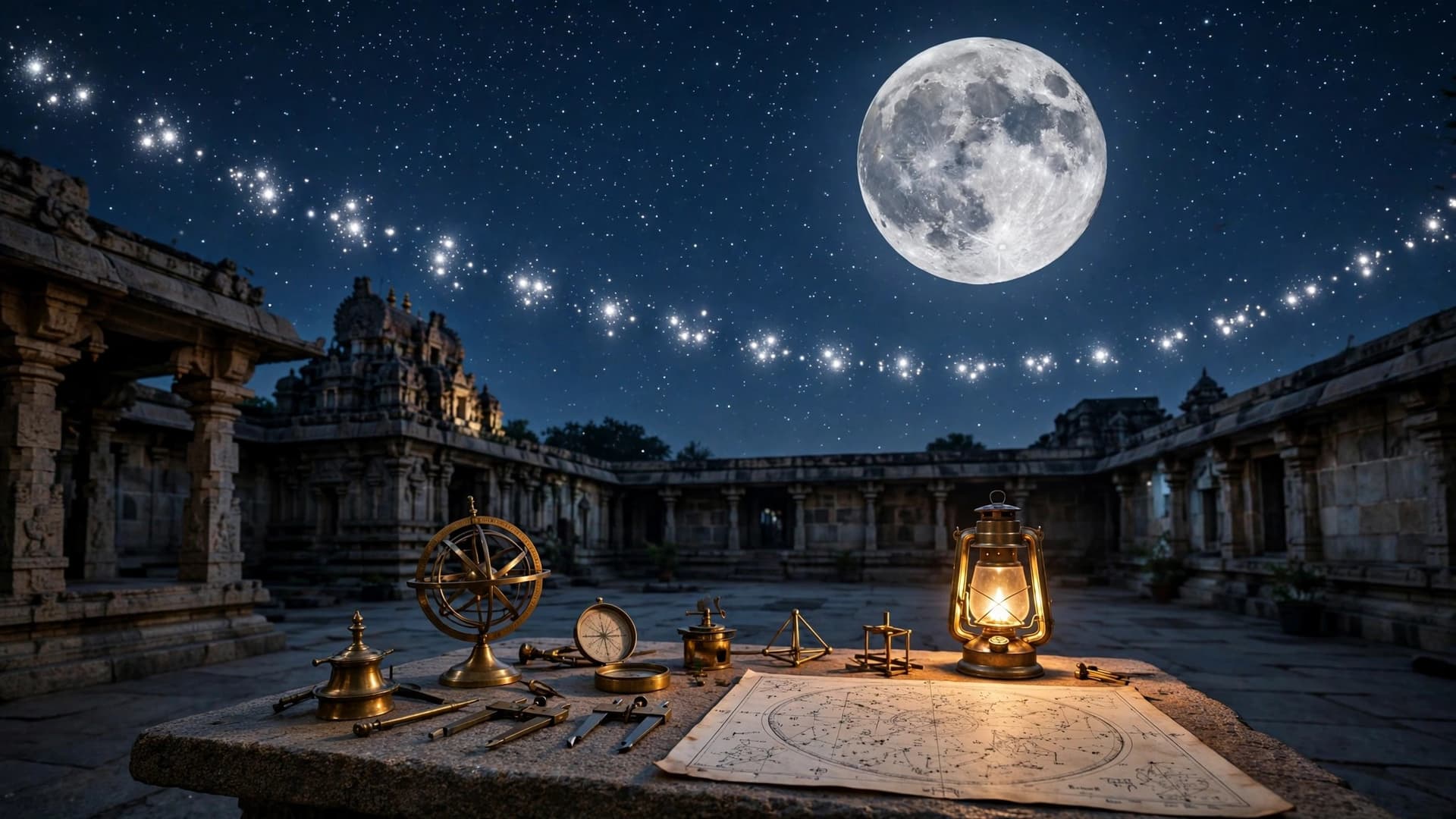
Executive Overview: Your nakshatra is the lunar mansion the Moon occupied at your birth — a 13-degree-20-minute slice of the sky that Vedic astrology treats as the most personal layer of your chart. It shapes instinctive temperament, sets your Vimshottari dasha sequence, and drives key parts of Kundali Milan matching. Find yours with the Nakshatra Finder, then read what it means below.
Most people know their Sun sign. Fewer know their Moon sign. Almost nobody outside Vedic astrology knows their nakshatra — yet in the Indian tradition it is the oldest and most intimate layer of the chart, older in practice than the twelve-sign zodiac itself. If your Sun sign is the public face and your Moon sign is the private emotional weather, your nakshatra is the specific star-field the Moon was travelling through when you were born, and it colours both.
What exactly is a nakshatra?
The Moon takes about 27.3 days to circle the zodiac. Vedic astrologers divided that circle into 27 equal lunar mansions, one for each day of the Moon's sidereal month. Each nakshatra spans exactly 13 degrees 20 minutes of the sky (360 divided by 27), and each is further divided into four padas, or quarters, of 3 degrees 20 minutes each. That gives 108 padas in total — a number that recurs all through Indian tradition, from prayer beads to dance forms.
Every nakshatra carries its own ruling planet, symbol and temperament. Pushya is traditionally called the most auspicious nakshatra, the star of nourishment, ruled by Saturn. Rohini is the sensual creator, Magha carries ancestral authority, and Hasta is the skilled maker. But there is no bad birth star: each nakshatra has gifts, and each has a shadow side that shows up under stress.
The system is sidereal, meaning it is measured against the fixed stars rather than the seasons. That is why your nakshatra comes from the Vedic (Lahiri) position of the Moon, not the tropical position used in most Western horoscopes. The two zodiacs currently sit about 24 degrees apart, so a Moon that is tropical Leo may well be sidereal Cancer — and its nakshatra follows the sidereal position.
The 27 nakshatras at a glance
Here is the full sequence, with each nakshatra's span and ruling planet. The ruling planet matters more than it first appears: it is the planet whose dasha period you are born into, which is why the table below is also the key to your life-timing map.
| Nakshatra | Span | Ruling planet |
|---|---|---|
| Ashwini | 0°–13°20' Aries | Ketu |
| Bharani | 13°20'–26°40' Aries | Venus |
| Krittika | 26°40' Aries–10° Taurus | Sun |
| Rohini | 10°–23°20' Taurus | Moon |
| Mrigashira | 23°20' Taurus–6°40' Gemini | Mars |
| Ardra | 6°40'–20° Gemini | Rahu |
| Punarvasu | 20° Gemini–3°20' Cancer | Jupiter |
| Pushya | 3°20'–16°40' Cancer | Saturn |
| Ashlesha | 16°40'–30° Cancer | Mercury |
| Magha | 0°–13°20' Leo | Ketu |
| Purva Phalguni | 13°20'–26°40' Leo | Venus |
| Uttara Phalguni | 26°40' Leo–10° Virgo | Sun |
| Hasta | 10°–23°20' Virgo | Moon |
| Chitra | 23°20' Virgo–6°40' Libra | Mars |
| Swati | 6°40'–20° Libra | Rahu |
| Vishakha | 20° Libra–3°20' Scorpio | Jupiter |
| Anuradha | 3°20'–16°40' Scorpio | Saturn |
| Jyeshtha | 16°40'–30° Scorpio | Mercury |
| Mula | 0°–13°20' Sagittarius | Ketu |
| Purva Ashadha | 13°20'–26°40' Sagittarius | Venus |
| Uttara Ashadha | 26°40' Sagittarius–10° Capricorn | Sun |
| Shravana | 10°–23°20' Capricorn | Moon |
| Dhanishta | 23°20' Capricorn–6°40' Aquarius | Mars |
| Shatabhisha | 6°40'–20° Aquarius | Rahu |
| Purva Bhadrapada | 20° Aquarius–3°20' Pisces | Jupiter |
| Uttara Bhadrapada | 3°20'–16°40' Pisces | Saturn |
| Revati | 16°40'–30° Pisces | Mercury |
Notice how the nine ruling planets cycle in the same order again and again — Ketu, Venus, Sun, Moon, Mars, Rahu, Jupiter, Saturn, Mercury — three full rounds of nine. That repeating order is not a coincidence: it is the same sequence the Vimshottari dasha system uses, which is why your birth nakshatra fixes your starting dasha.
A worked example: Moon at 18 degrees Taurus
Theory is easier with a real chart position. Take a birth with the Moon at 18 degrees sidereal Taurus and walk through it step by step.
First, the nakshatra. Taurus runs from 0 to 30 degrees, and Rohini covers 10°–23°20' of Taurus, so a Moon at 18° Taurus sits in Rohini. Rohini's ruling planet is the Moon itself.
Second, the pada. Rohini's four padas are 10°–13°20' (pada 1), 13°20'–16°40' (pada 2), 16°40'–20° (pada 3) and 20°–23°20' (pada 4). A Moon at 18° falls in pada 3. Each pada maps to a navamsa sign and refines the reading — the same nakshatra in a different pada is read with a different flavour, which is one reason two Rohini natives can feel quite different.
Third, the dasha balance. The Moon has 5°20' left to travel in Rohini (23°20' minus 18°). That is 5.333 degrees out of Rohini's full 13.333-degree span, exactly 0.4 of the nakshatra. Rohini is ruled by the Moon, whose dasha lasts 10 years, so the Moon dasha balance at birth is 0.4 × 10 = 4 years. After those 4 years, Mars dasha (7 years) follows, then Rahu, and so on in the fixed order. One Moon position thus unlocks the whole timing sequence — and you can check the same arithmetic in the Dasha Calculator, which builds your full timeline from your birth Moon.
If you do not know your Moon's sidereal position yet, the Nakshatra Finder works it out from your birth date, time and place. Birth time matters more here than for Sun-sign work: the Moon moves about 13 degrees a day, roughly half a degree an hour, so a few hours of error can shift the nakshatra near a boundary.
Nakshatra versus Moon sign: what is the difference?
A Moon sign (rashi) is a 30-degree sign; a nakshatra is the narrower 13-degree-20-minute star segment inside it. Each sign contains two and a quarter nakshatras. The sign gives the broad temperament; the nakshatra gives the precise flavour.
Two people with the same Moon sign but different nakshatras are read very differently by a Vedic astrologer. A Cancer Moon in Pushya reads as nourishing, protective and steady, while a Cancer Moon in Ashlesha reads as intense, perceptive and private. Same sign, same element, same ruling planet for the sign — but a different star, a different deity, a different instinctive style. That is why families in India traditionally note the birth nakshatra on the horoscope itself, and why it is often the first thing a Vedic astrologer asks about after the birth time.

Why your nakshatra matters beyond personality
Your nakshatra is not just a personality label. It does three pieces of real work in a Vedic chart.
First, it sets your dasha sequence, as the worked example above shows. Your birth nakshatra's ruler opens your life's timing chapters, and the remaining balance of that first period shapes every date that follows. The companion guide to Vimshottari Dasha periods explains the full 120-year cycle in detail.
Second, it drives Kundali Milan matching. Three of the eight Ashtakoota factors come straight from the Moon's nakshatra: gana (temperament class), nadi (constitution) and yoni (animal symbol and instinctive compatibility). A match can score well on sign-based factors and still stumble on nadi, which is why the Kundali Milan Calculator and the Kundali Milan 36 guna guide both treat the nakshatra as foundational rather than decorative — and why the Manglik Dosha guide is often read in the same sitting, since Mars placement is the other matching question families ask first.
Third, it traditionally guides naming. Each pada is linked to starting syllables for a child's name — Ashwini padas give Chu, Che, Cho and La; Bharani gives Li, Lu, Le and Lo; Krittika gives A, I, U and E; Rohini gives O, Va, Vi and Vu. Many families still pick a name from the birth pada even when the everyday name is something else entirely.
Common misunderstandings, cleared up
One: your nakshatra is not your Sun-sign equivalent. It is lunar, not solar. People who look up "my nakshatra" from their Sun sign are reading the wrong star entirely.
Two: a nakshatra near a sign boundary belongs to the sign its degrees fall in, not the sign you feel attached to. Krittika, for example, straddles Aries and Taurus: a Moon at 28° Aries is Krittika in Aries, while a Moon at 5° Taurus is Krittika in Taurus. The nakshatra is the same; the sign — and therefore the Moon-sign reading — differs.
Three: two calculators can disagree near a boundary, and neither is necessarily broken. Different ayanamsa values shift the sidereal longitude slightly, and date-only calculators approximate the Moon's position instead of computing it from the birth moment. If your Moon sits within about a degree of a boundary, an ephemeris-grade chart computed from your exact birth time is the deciding figure — which is why the Nakshatra Finder asks for time and place rather than date alone.
Four: there is no hierarchy of good and bad birth stars. Pushya's reputation as the most auspicious nakshatra is real tradition, but every nakshatra has strengths that become weaknesses only when overused — Rohini's love of comfort can become indulgence, Magha's authority can become pride, Ashlesha's perception can become suspicion. The useful question is never "is my nakshatra good?" but "what does this star ask me to handle well?"
How to use your nakshatra result
Start with the temperament description, but do not stop there. Read your Moon sign alongside it — the sign is the landscape, the nakshatra is the weather station inside it. Then check your dasha: your birth nakshatra's ruler tells you which planetary chapter you opened life in, and the balance tells you how long it ran. Finally, if marriage matching is on your mind, look at gana, nadi and yoni together rather than any one factor alone; a single mismatch has never been the whole story of a relationship.
Your nakshatra is the smallest named unit of Vedic astrology and, paradoxically, the one that unlocks the most of the chart. Learn it once, and the rest of the system — dashas, matching, even naming — starts to join up.
Frequently asked questions
How do I find my nakshatra?
Use the Nakshatra Finder with your birth date, exact birth time and birthplace. It computes the Moon's sidereal (Lahiri) longitude and returns your nakshatra, pada, ruling planet and deity. Date-only tools approximate and can be wrong near boundaries.
Is my nakshatra the same as my Moon sign?
No. Your Moon sign is the 30-degree sign the Moon occupied; your nakshatra is the 13-degree-20-minute segment within it. Each sign holds two and a quarter nakshatras, so the nakshatra is the finer, more personal measurement.
Why does my nakshatra decide my dasha?
Vimshottari dasha gives the Moon's remaining journey through its birth nakshatra to that nakshatra's ruling planet. The fraction of the nakshatra already crossed at birth is the fraction of the first dasha already lived, so the nakshatra fixes both the starting planet and the balance period.
What is a pada and does it change my nakshatra?
Each nakshatra has four padas of 3 degrees 20 minutes. The pada does not change the nakshatra, but it maps to a navamsa sign, refines personality readings, and traditionally supplies the starting syllables for naming.
Which nakshatra is considered the best?
Pushya is traditionally called the most auspicious — the star of nourishment, ruled by Saturn. Rohini, Uttara Phalguni and Shravana are also highly prized. But every nakshatra has gifts, and none is a bad birth star.
Can my nakshatra differ between two calculators?
Yes, near boundaries or when calculators use different ayanamsa values or date-only approximations. The Moon's exact sidereal longitude at your birth time is the deciding figure.